

Make Change Easier
Foundational Levels

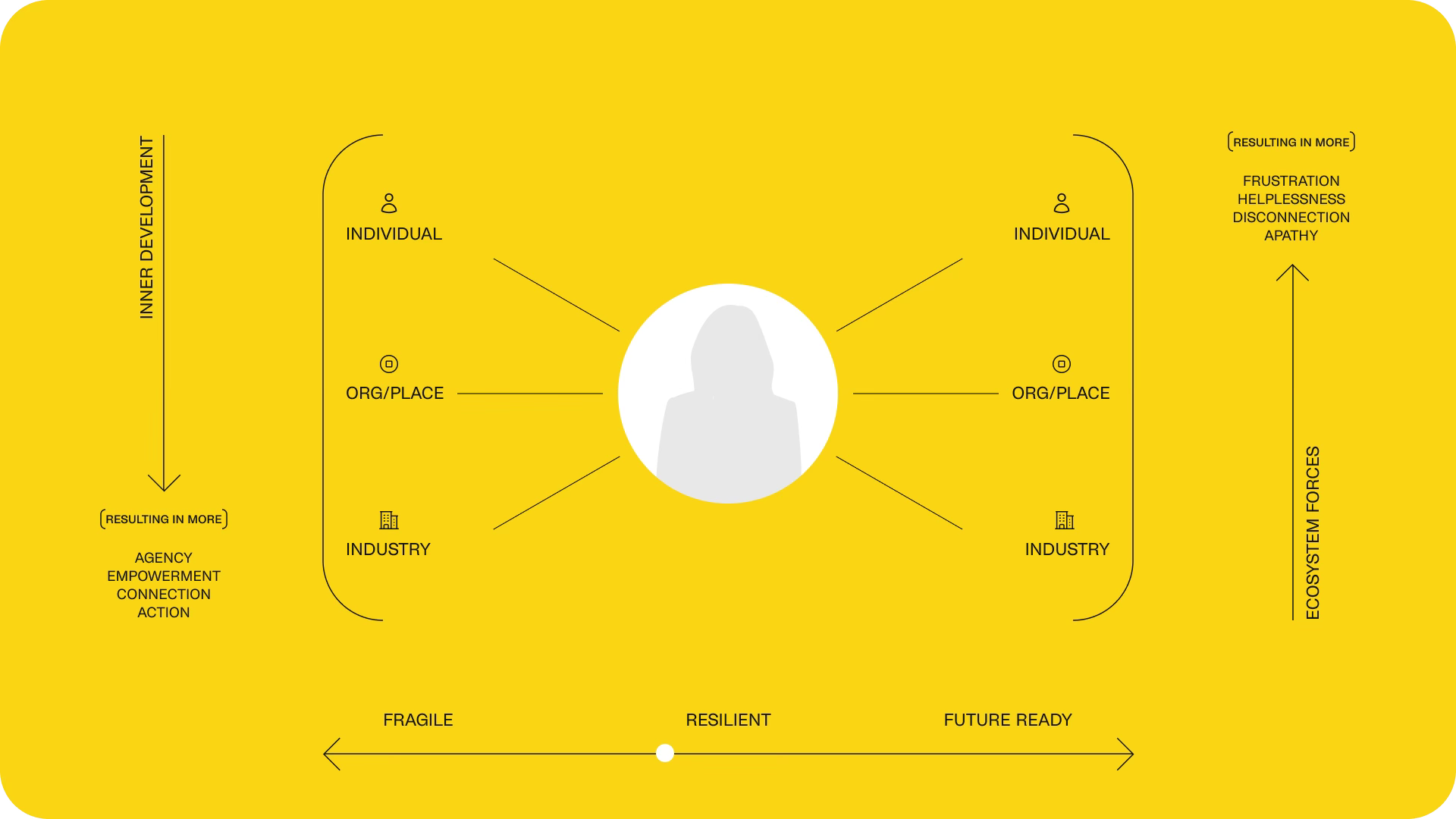
I’ve been asked for years how all my work connects. This is the clearest answer I’ve managed so far.
Most of my working life has been spent watching capable people burn themselves out trying to change things that clearly needed changing.
Different sectors. Different roles. Same pattern.
Smart individuals pushing harder.
Teams stuck in endless workshops.
Organisations launching transformations that never quite land.
Industries talking about transition while doing basically the same thing.
Places full of well-intentioned strategies that never meet reality.
The problem was never a lack of effort or intelligence.
It was the way change was being approached.
We tend to treat change as a single problem at a single level.
Fix the mindset.
Fix the team.
Fix the strategy.
Fix the market.
Fix the system.
Pick one. Push harder. Act surprised when it doesn’t stick.
After years of working inside businesses, alongside public sector leaders, across supply chains, and at industry and place level, the pattern became hard to ignore:
Change fails when we isolate it.
Change works when the levels line up.
That observation is where Make Change Easier came from. Not as a slogan. As a response to how unnecessarily hard we’ve made this.
The core idea is simple, even if the work isn’t:
Change only holds when individual, team, organisational, industry or place, and ecosystem dynamics are designed to support each other.
Ignore one level and the others pay the price.
At the individual level, change breaks when people are exhausted, confused, or asked to carry responsibility without authority. Skills, confidence, decision-making, and identity all matter here. You can’t “scale” past human reality, no matter how good the strategy looks on paper.
At the team level, things fail when roles are fuzzy, incentives clash, and collaboration is assumed instead of designed. Most delivery problems are really team problems that have been politely ignored.
At the organisation or business level, the usual culprits show up: unclear strategy, broken operating models, legacy processes, misaligned metrics. This is where good intentions go to die if execution isn’t redesigned alongside ambition.
At the industry or place level, individual organisations hit ceilings they can’t break alone. Skills shortages, fragmented supply chains, misaligned regulation, weak demand signals, risk sitting in the wrong places. No amount of internal optimisation fixes a broken market context.
And at the ecosystem level, the biggest failure mode appears: everyone acting rationally in isolation while the system produces irrational outcomes. Investment, policy, innovation, skills, and infrastructure drift out of sync. Progress stalls. Frustration rises. Reports multiply.
What Make Change Easier does is refuse to pretend these levels are separate.
Leadership development without organisational redesign is theatre.
Business transformation without industry alignment is fragile.
Place-based strategies without capable local organisations are wishful thinking.
AI deployed without change management just automates dysfunction faster.
That’s why my work looks broad from the outside and coherent from the inside.
Industry Transition Accelerators exist to realign incentives, capability, and demand across whole sectors.
Business and AI audits exist to ground ambition in operational reality and make change executable.
Leadership development exists to help people operate with clarity and agency inside that reality.
Place-based programmes exist to convene actors who can’t solve shared problems on their own.
Different entry points. One model.
Theory matters because without it you repeat the same mistakes with new language.
Practice matters because theory without delivery is just performance.
AI matters because, used properly, it lowers friction, exposes bottlenecks, and gives people leverage. Used badly, it just makes the mess harder to unwind.
So when you see me writing about construction, or AI-enabled growth, or supply chains, or leadership, or place-based transition, it’s not a grab-bag of interests. It’s one system viewed from different altitudes.
Future posts will zoom in and out.
Sometimes human. Sometimes organisational. Sometimes industrial or spatial.
Always connected.
If you’re dealing with real change, not just talking about it, you’ll know which level you’re operating at.
And you’ll probably recognise the cost of pretending the others don’t exist.
Yes, we need to take a holistic approach. That said, the big question is how to go about doing it with various challenges at each level and oftentimes a lack of influence at all levels at once. I would be very much interested in concrete actions you'd propose.